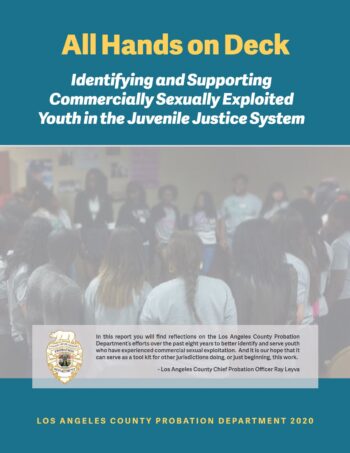
All Hands on Deck: Identifying and Supporting Commercially Sexually Exploited Youth in the Juvenile Justice System
This report details Los Angeles County Probation Department's efforts over the past eight years to better identify and serve youth who have experienced commercial sexual exploitation (CSE).
Click to read 
Supporting the Mental Health of Youth in Juvenile Court – Resource Guide and Bench Cards
Up to 80 percent of youth in foster care have significant mental health issues as compared to approximately 22 percent of youth in the general population. Up to 70 percent of youth who touch the juvenile justice system have a diagnosable mental health issue.
Click to read 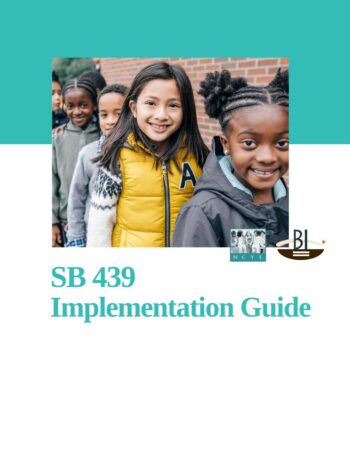
Senate Bill 439 (2018) Implementation Guide
Under SB 439, counties must develop a process for determining the least restrictive responses that may be used instead of or in addition to the release of the child to their parent, guardian, or caregiver.
Click to read 
Antelope Valley Community Resource Guide
The National Center for Youth Law (NCYL) has compiled a Community Resource Guide of available programming and services for young people in the Antelope Valley region of Los Angeles County.
Click to read 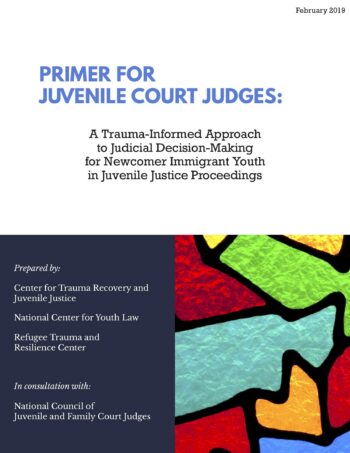
Primer for Juvenile Court Judges: A Trauma-Informed Approach to Judicial Decision-Making for Newcomer Immigrant Youth in Juvenile Justice Proceedings
This primer and accompanying benchcard for juvenile court judges presents a trauma-informed approach to judicial decision-making for newcomer immigrant youth in juvenile justice proceedings.
Click to read Trauma-Informed Legal Advocacy: A Resource for Juvenile Defense Attorneys
This resource is intended to provide juvenile defense attorneys with an increased understanding of what trauma-informed legal advocacy entails, how trauma impacts child development, the attorney-client relationship, family and caregivers, and attorneys themselves.
Click to read 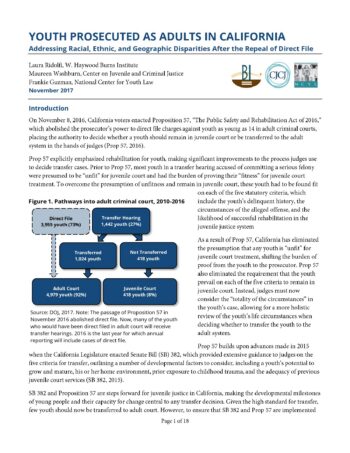
Youth Prosecuted As Adults In California: Addressing Racial, Ethnic, And Geographic Disparities After the Repeal of Direct File
In 2016, Californians voted overwhelmingly in support of Proposition 57, a ballot initiative that abolished the practice of “direct file,” wherein prosecutors could file charges against youth as young as 14 years old directly in adult criminal court.
Click to read